European startupsCompany profile
Cradle: the Amsterdam AI platform drug makers use to design proteins
Cradle, the Amsterdam and Zurich AI protein design platform: its five founders, three rounds worth over USD 100 million and 2026 deals with Bayer and UCB.

Contents
Cradle is a Dutch and Swiss company that sells software for designing proteins with artificial intelligence. Scientists give it a protein they want to improve, an antibody, an enzyme or a vaccine, and the model suggests variants worth testing in the lab. Founded in 2021 and based in Amsterdam and Zurich, the company says it has raised more than USD 100 million from investors. In 2026 it signed collaborations with four European drug makers.
Five founders from Google, Uber and synthetic biology
Cradle's team page lists five co-founders: CEO Stef van Grieken, Jelle Prins, Elise de Reus, Harmen van Rossum and Eli Bixby. According to the Dutch outlet IO+, van Grieken previously worked at Google and Prins was Uber's first employee, in charge of the app's design. The company describes its team as a mix of people from large technology firms and biologists and engineers who know their way around a lab.
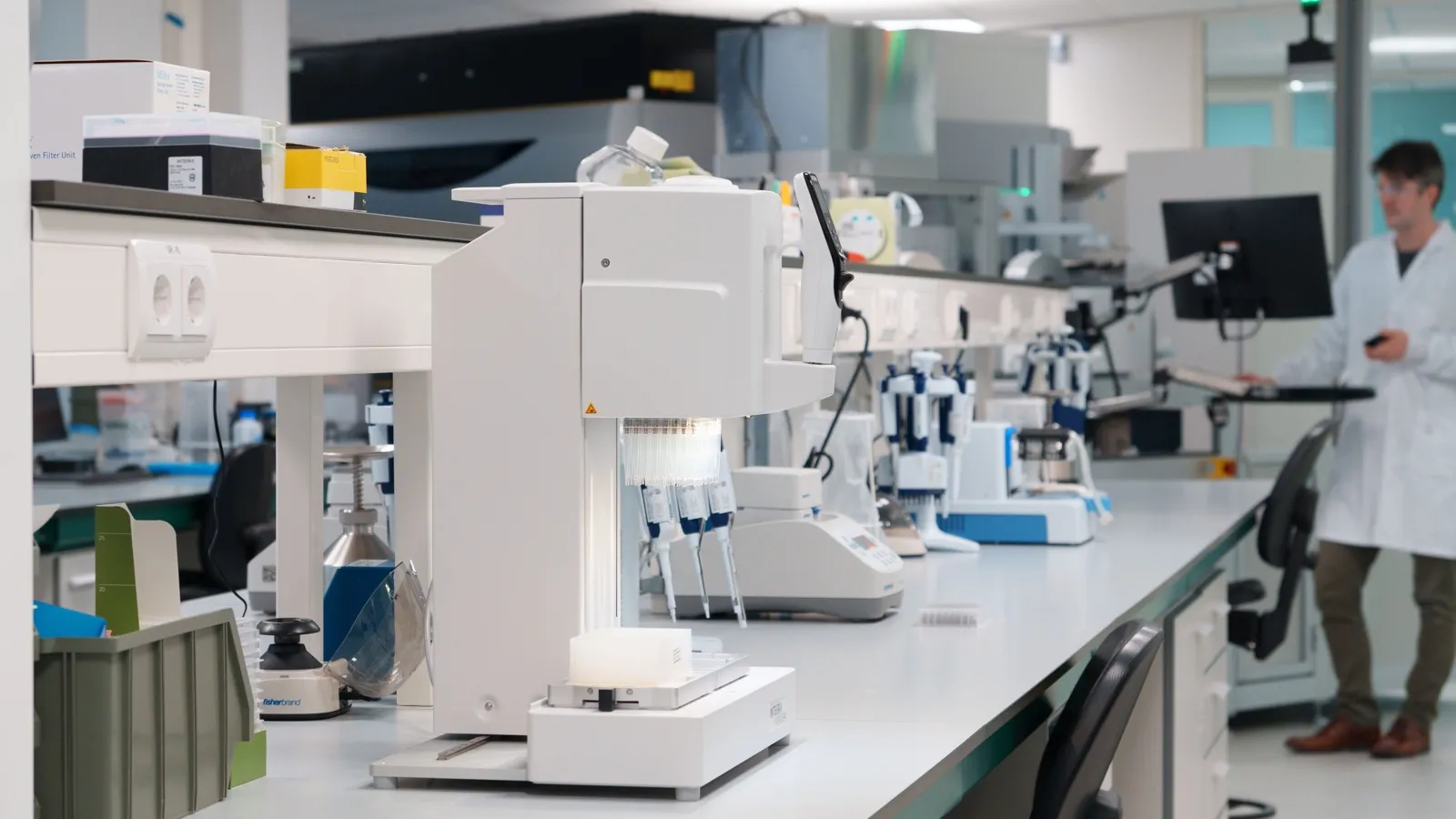
Cradle came out of stealth in November 2022 with offices in Delft and Zurich. Today it lists Amsterdam, Zurich and the United States. In Amsterdam it runs its own wet lab, where it tests model designs and gathers training data. The company calls this loop, in which lab results keep refining the model, "lab-in-the-loop".
Fewer experiments, better candidates
The idea is straightforward: instead of a lab screening large numbers of random protein variants, the model proposes a smaller set of more promising candidates. Cradle says it speeds up early research for customers by 1.2 to 12 times and cuts costs by up to 90%. These are company figures; it has not published independent verification.
Customers named by Cradle include Novo Nordisk, Johnson & Johnson Innovative Medicine, Novonesis and Grifols. A December 2025 update says it works with Novo Nordisk on GLP-1 therapeutic candidates. In June 2026 it added Guided Rounds, a feature that walks users through one design round from raw data to lab-ready candidates.
Three rounds, more than USD 100 million
Every round was announced on the company blog. Cradle has not published a valuation or revenue.
| Item | Value | Source |
|---|---|---|
| Founded | 2021 | IO+ |
| Base | Amsterdam and Zurich, team also in the US | Cradle |
| Co-founders | Stef van Grieken (CEO), Jelle Prins, Elise de Reus, Harmen van Rossum, Eli Bixby | Cradle |
| Seed, 17 Nov 2022 | EUR 5.5m, co-led by Index Ventures and Kindred Capital | Cradle |
| Series A, 28 Nov 2023 | USD 24m, led by Index Ventures; USD 33m raised in total | Cradle |
| Series B, 26 Nov 2024 | USD 73m, led by IVP; over USD 100m in total | Cradle |
| Team | 20 people (Nov 2023), 40th team member (Nov 2024), doubled by Dec 2025 | Cradle |
| Customers, Nov 2024 | more than 21 customers, 31 proteins in development | Cradle |
| Scale, Dec 2025 | more than 50 R&D programs, 6 of the top 25 pharma companies | Cradle |
Alongside the funds, the seed round brought in angels Feike Sijbesma, former CEO of DSM, and Emily Leproust, founder of Twist Bioscience. The Series A added angel money from Chris Gibson of Recursion and Tom Glocer, former CEO of Thomson Reuters. The Series B was earmarked for a larger wet lab, a bigger engineering team and sales.
How investors put a value on a private company whose revenue is not public is covered in How to value a company by revenue.
Bayer, Lundbeck, Hansa and UCB in one year
For Cradle, 2026 was mostly a year of new pharma customers. It disclosed no financial terms for any of these deals.
- Bayer (7 January 2026): a three-year collaboration giving Bayer's antibody scientists full platform access, plus a joint machine learning research project.
- Lundbeck (3 June 2026): the Danish brain health company will first use the platform in two antibody programs.
- Hansa Biopharma (1 October 2026): the Swedish company will apply it to treatments for severe autoimmune diseases.
- UCB (4 November 2026): the Belgian company will use it in selected projects from hit generation to preclinical readiness.
On the same day as the UCB news, Cradle held Unfold 2026, its first user meeting, in Boston. According to its 16 November 2026 recap, customers asked for more model transparency and more self-service, and Cradle responded with the Cradle Academy guides and machine-to-machine tokens for customers' own automation.
What to watch at Cradle
- Next funding round: the company has announced no round since the November 2024 Series B, while it says it doubled its team in 2025.
- Partnership outcomes: whether the pharma deals lead to candidates in clinical development and whether milestone payments are ever disclosed.
- Competition: AI protein design attracts start-ups as well as large technology and pharma companies with their own models.
- Group structure: with a foreign company it is worth checking which entity issues the shares and where it is registered. Plans for researching companies across national registers in JOuInvest are on the pricing page.
Questions
What does Cradle do?
It sells a software platform in which scientists use machine learning to design and improve proteins such as antibodies, enzymes, peptides and vaccines. The model proposes variants, the lab tests them and the results flow back into the model. Cradle also runs its own wet lab in Amsterdam.
Who founded Cradle?
Five co-founders: CEO Stef van Grieken, Jelle Prins, Elise de Reus, Harmen van Rossum and Eli Bixby. According to IO+, the company was founded in 2021; van Grieken previously worked at Google and Prins was Uber's first employee, responsible for the design of its app.
How much has Cradle raised?
The company announced a EUR 5.5 million seed in November 2022 (Index Ventures and Kindred Capital), a USD 24 million Series A in November 2023 (led by Index Ventures) and a USD 73 million Series B in November 2024 (led by IVP). It says the total is over USD 100 million. No valuation has been published.
Does Cradle publish revenue?
No. It reports customer and project counts instead: more than 21 customers and 31 proteins in development in November 2024, and more than 50 R&D programs with six of the top 25 pharma companies as users in December 2025.
Sources
- Cradle: We've raised $5.5M to design protein-machines and cell-factories with AI (17 Nov 2022), accessed 17 Nov 2026
- Cradle: Cradle raises $24M Series A and signs partnerships with industry leaders (28 Nov 2023), accessed 17 Nov 2026
- Cradle: Cradle raises $73M Series B (26 Nov 2024), accessed 17 Nov 2026
- Cradle: AI-powered protein engineering platform serving six of top 25 pharma leaders (12 Dec 2025), accessed 17 Nov 2026
- Cradle: Bayer and Cradle enter collaboration (7 Jan 2026), accessed 17 Nov 2026
- Cradle: Lundbeck partners with Cradle (3 Jun 2026), accessed 17 Nov 2026
- Cradle: Hansa Biopharma partners with Cradle (1 Oct 2026), accessed 17 Nov 2026
- Cradle: UCB advances its digital antibody engineering program with new Cradle collaboration (4 Nov 2026), accessed 17 Nov 2026
- Cradle: Press kit (logo and laboratory photo), accessed 17 Nov 2026
- IO+: Jelle Prins, Cradle founder: I thought my peak had passed after leaving Uber (27 Jun 2024), accessed 17 Nov 2026
This article is general information, not tax, legal or investment advice.